New diddy recorded May 2012 in Mongolia
Sunday, May 20, 2012

Friday, May 18, 2012
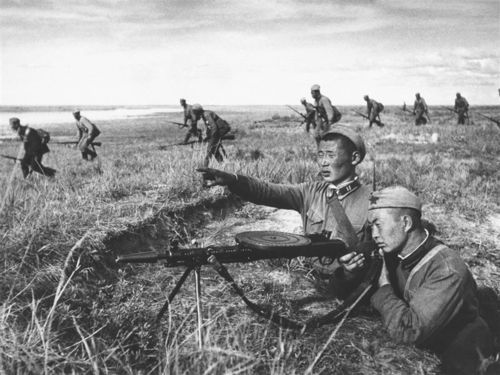
The Battle of Khalkhiin Gol
By Cooper Baltis
published Friday May 18th in the UB Post
Oftentimes, in the always dramatic stage of world history,
the smallest acts go on to have the largest impacts.
A seldom mentioned engagement in the Western history classes,
the 1939 Battle of Khalkhiin Gol fought between
Soviet/Mongolian forces and Japanese forces in Eastern Mongolia went on to have
a fundamental impact on the way Japan conducted its World War II campaign.
While the month of May might mark the anniversary of the
nearly three month battle, the conflict started two decades beforehand in the
1910s. As the Tsarist Empire dissolved due to the Communist powers, Japan
briefly occupied pieces of Siberia and a handful of eastern Soviet provinces,
leading to many disputes and petty battles. As Communist powers solidified in
the early 1920s, the Japanese army slowly withdrew from the territories,
tucking their tails between their legs and vowing to return. Regrouped and refueled
by nationalistic imperialism, Japan drew back into the disputed areas in the
1930s, setting up the puppet state of Manchukuo and eventually seizing Shanghai
and Nanking.
With Japan again on its borders, and fearing the possible
repercussions of the Anti-Comintern Pact signed between Germany and Japan, Soviet
Russia began sending financial and military aid to the Chinese. Tensions were
also stirred by the ‘Strike North’ faction in the Japanese military strategy.
Proponents of this faction argued that by cutting the Trans-Siberian lifeline,
Japan could quickly expand into Mongolia and Siberia as well as eastern Soviet
provinces. This buffer zone would then allow Japan to harness the natural
resources of Manchukuo.
Bisected by the Holsten River, the Halhna River (Khalkhiin Gol)
flowed north to south in the eastern Mongolian in the Dornod aimag. The
conflict started when close to 100 Mongolian men entered the disputed territory
in search of a grazing area for their horses. A Japanese cavalry attacked the
Mongolians, driving them back across the Khalkin Gol. Two days later, Mongolian
forces returned seeking vengeance.
By the end of May 1939, Soviet forces commanded by General
Georgy Zhukov and the 6th Japanese army, consisting of 20,000 men,
had moved into the area. A battle was fought from May 28 to 29, eventually
ending in a draw.
As June progressed, skirmishes increased near the village of
Nomonhan, which lead to Japanese General Michitaro Komatsubara getting orders
to use any means necessary to expel the invaders. The Japanese planned on a two
prong attack, but were ultimately unsuccessful as the Mongolian and Soviet
forces were able to prevent the two wings from meeting.
Supply problems arose in July for Soviet and Mongolian
forces as nearest supply base was 748 kilometers away. The supply anguish was
felt by the Japanese, as supply transports from Manchukuo were few and far
between. By the end of July, the battle
had come to a standoff, and rather than risking more causalities, the Japanese
army disengaged from the battle to give time for General Komatsubara to ready a
counteroffensive. While casualties have been disputed on the Japanese side,
deaths in the thousands were officially reported on both sides. Soviets claimed
to have taken 60,000 Japanese lives, while the Japanese army records indicate
this number was closer to 9,000. Mongolian and Soviet forces suffered over
8,000 deaths with 15,000 wounded.
Before General Komatsubara had a chance to attack, a
cease-fire was signed in Moscow, which eventually led to the signing of the
Molotov-Ribbentrop Pact at the end of August. The Molotov-Ribbentrop Pact was a
non-aggression pact signed between Germany and the Soviet Union, which directly
affected Japan’s expansionistic plans through Central Asia. It also the Soviets
the opportunity to focus solely on one front if need be. By September 1, World
War II had started and Japan had begun its preparations to focus on its
campaign solely on the Pacific.
This change in strategy creates ripples regarding the
historical outcome of World War II. With its South Strike Group policy in
effect, Japan began aggressively pursuing Southeast Asian targets. The results
of the Battle of Khalkhiin Gol also made it geographically impossible for
Germany and Japan to unite their control through the Soviet landmass. It was
also a victory for the Soviet General Zhukov, who would go on to become the
most decorated general in the history of Russia. The Japanese decision to focus
on Southeast Asia created a scenario in which the Soviet Union wasn’t fighting
two fronts, allowing them to focus all their military might on fighting Nazism
in the West. This put pressure on the Nazi regime, as the war on both of
Germany’s borders became hard to handle.
About a nine hour drive from Choisbalsan, Khalkhiin Gol is
now a war memorial site complete with a museum and the ten meter high Yalaltiin
Khoshuu monument. It is a quiet place in the middle of nowhere, behind a border
checkpoint and blanketed by cerulean Mongolian skies. It’s a site that many
argue changed the course of Japanese aggression during World War II, a place
where many men took their final resting ground.
Monday, May 14, 2012
Sunday, April 8, 2012
The Bumba Chronicles


Photos and translations by B. Solongo
Published April 9 in the UB Post
I now lay in Ulaanbaatar on a bed at the Setgeshgui Clinic, a traditional medical center nestled in the center of a bustling apartment complex near Strings, the infamous Mongolian nightclub. The flesh on my back is being sucked up into glass bulbs like inverted droplets of rain onto the surface of a shallow puddle. Next to me is an older Mongolian man, his face ripe with age and his skin leathery with wisdom. Two weeks ago I began getting a traditional Mongolian medical treatment called bumba, and am proud to say that it is working.
I close my eyes and tuck my hands under the blanket that is partially covering my back. The smell of seared newspaper enters my nostrils with every inhale. Exhales are met with a tightness stemming from the glass bulbs on my back. The sound from a boxy television nearby playing a Mongolian opera fills my skull with the low hum of euphonious grandiosity and jittery static.
A note on my condition: one year ago, I arrived in Delhi, India late at night with an unexpected passenger. My sciatic nerve, the longest single nerve in the human body running from the lower back through the buttocks and down to each foot, throbbed with every step I took. I arrived an hour later in Majnukatilla, a Tibetan refugee community on the outside of Delhi, and limped to the nearest hotel.
Instead of resting or visiting a hospital in Majnukatilla like any sane person would have done (although this begs the question on who in their right mind would travel through India anyhow, a question answerable only by those who have embarked), I decided to continue my journey to Dharamsala, seat of His Holiness the Dalai Lama. Looking back, this was likely the worst choice to be made considering my condition.
Foolishly (or tenegly in Monglish), I boarded a bus aimed at Dharamsala, a 12 hour headache inducing ride atop crumbling Indian roads hastily laid through the rolling hills of the Punjab. Naturally, the bus got in a wreck, which left me hitchhiking across northern Indian for the next day. As one can image, all this activity only worsened my sciatic nerve injury.
A year has passed since the India injury and about once a week, I’ll wake up with my right leg tingling in pain. On these days, I usually gimp around as if I were suffering from a leg length discrepancy. Two weeks ago, on one of the reoccurring leg injury days, I broke down and asked my students if there was a traditional way to fix my nerve problem.
One or my students, let’s call her Sunny because that’s what she likes to be called, suggested I visit the Setgeshgui Clinic, the first private clinic to be established in democratic Mongolia. Two day later, I found myself in a waiting room with Soko, another student who would act as my translator.
After a little confusion on my part (making the tough decision between plastic bags to cover one’s feet and sandals six sizes too small) I met with Dr. Khurelbaatar, who quickly surmised after feeling the pulse on both my wrists that something was wrong with my neck (which was affecting my back, which was in turn affecting my leg). He explained through Soko that I needed bumba treatment (known in the West as fire cupping), and would likely need to visit the clinic between five and ten times.
Opening the Setgeshgui Clinic 21 years ago, Dr. Khurelbaatar has successfully treated countless ailments including but not limited to: migraines, hypertension, head trauma, epilepsy, slipped disks, liver and kidney disease, tachycardia, rheumatism, bronchitis, concussions and bladder disorders.
Dr. Khurelbaatar has published a book in Germany about Mongolian hypnosis, Hypnose in Der Mongolei (he’s currently searching for someone to perform a German to English translation), a book of poetry, is a former member of the American Society of Clinical Hypnosis and is a recipient of the Chingis Khaan Academy Award for his contributions in developing the Mongolian medical sector. As his clinic practices tradition medicine, he receives no funding whatsoever from the Mongolian government. He believes that Western medicine is too quick to resort to medicine and surgery, a belief I too hold after seeing my father suffer after taking the medicine prescribed to him by Western doctors.
Dr. Khurelbaatar sits behind me before the bumba treatment is set to begin. Each treatment is preceded by a chiropractic massage by either Dr. Khurelbaatar or Dr. Davaahuu, a lively man who claims to speak sixteen languages and is instantly recognizable by his crimson nurse’s smock.
As Dr. Khurelbaatar massages the back of my neck, I begin to cringe. He presses his fingers into the apex where my neck meets my back and holds them there, pushing deeper and slightly curving his fingers inward.
“Yooooooooi…” I lament, trying to sound as Mongolian as possible.
A Mongolian woman wearing a threadbare pink deel adorned with bright yellow flowers looks up at me curiously. Next to her, a teenager wearing a New York Yankees hat texts rapidly on his cell phone. Beside the teenager is a man in a white tank top, his eyes caramel and his right shoulder showing the outline of a faded tattoo.
“Pain?” the doctor asks, pressing harder into my neck.
“yes…tii…yoooiii…” I answer.
“Sain (good). Pain sain…” the doctor replies, smiling at the group of now laughing Mongolians flanking the massage area. I laugh with them while wincing.
After the massage, I’m instructed to take off my shirt and lie down on one of the beds. Sometimes I’m assigned to a single bed and others, a double bed which puts me elbow to elbow with another patient. A nurse comes around with something that looks like a deodorant stick but is actually filled with oil. All around me, candles slowly flicker and clients in the adjoined waiting room chat with Dr. Davaahuu, as he gives massages to patients waiting in what strikingly resembles an assembly line.
The nurse applies the oil to my back in two long strips that run parallel. She swiftly lights a piece of newspaper, stuffs it into a glass bulb, screwing it onto my back like a bottle cap. I can feel the skin on my back quickly suck into the bulb as the smoke whittles away, consuming all the oxygen in the glass bulb. The end result feels similar to suction cups, and while it might look painful, it’s absolutely painless.
Bumba, or fire cupping, is a form of traditional medicine practiced that has been practiced from the steppe of Asia to the Pyramids of Egypt. The first record of cupping can be found in the Ebers Papyrus, an Egyptian medical document that dates to 1550 BC. The ancient document contains information on everything from contraception to dentistry, and is considered one of the earliest medical texts. Cupping is thought to circulate blood flow to ultimately foster healing in the location in which the cups are placed.
There are three methods of cupping, including dry cupping, in which a glass bulb is used to suction the skin through various methods to create low pressure, fire cupping, which I’ve previous described, and wet cupping or hijama, a Middle Eastern practice in which a laceration is made with a scalpel on the skin before the cup is sunk into place. With the New Age movements of the West, cupping has featured somewhat of a resurgence in people seeking alternative treatments and new silicon cupping has become available.
My bumba session finishes with the hissing sound of the glass bulbs beings pried off my back. The nurse twists one cup at a time, wiping up any excess oil with a tissue as she makes her way down my spine. I am instructed to lie under a red heat lamp for four minutes to facilitate an even distribution of heat. Afterwards I dress and head to Dr. Khurelbaatar’s office, where he does a short hypnosis to finish the practice.
In the two weeks since I began treatment, I have noticed an astounding change in my condition and have felt new energy levels when after leaving the clinic. Bumba is definitely an unconventional treatment, yet so is having a team of doctors slice into my spine to fix the problem manually. Sometimes, there is a reason people have continued to do something for thousands of years, bumba falls into this category.
The Setgeshgui Clinic is located in Byanagol District, 4th micro region, building no 37. The clinic can also be reached by e-mail, setgeshgui@yahoo.com or by phone, 361491, 91912599.
The Goose is Loose

Published March 15, 2012 in the UB Post
Ornithologists and birdwatchers rejoice: Bar-headed Geese will be making their way back to the Mongolian mainland soon.
Yet another tie between the icy Buddhist peaks of the Tibet Plateau and Mongolia, the Bar-headed Geese migratory pattern sees the geese flying all the way from the furrowed brow of Russia to the lush tea gardens of India.
One of the highest flying birds in the world, Bar-headed Geese routinely fly over parts of the Himalayas during its migration. The northward migration from India is especially difficult and is carried out in stages. The geese wait until nightfall to begin the climb that lasts for hours. The Bar-headed Geese are aided in their mighty ascent by a larger than average wing area. Scientific studies have also revealed that the geese works more efficiently under low oxygen conditions, giving the geese the power to scale colossal heights and maintain equilibrium while in the air.
Not one to fly clear of controversy, Bar-headed Geese were accused of being early carriers of the H5N1 avian flu after an unexplainable outbreak in the Darkhan Valley of northern Mongolia. With no poultry farms in the area, the geese were immediately suspect and eventually proven guilty.
The mysterious outbreak in Darkhad Valley brought the attention of Ornithologists, who converged upon the region and began tagging the geese. Some of the geese tagged by the scientists were later seen in Somnathpur, India, a distance of nearly 4,780 kilometers.
The geese are now routinely collared, and sightings have continued to increase in India. The geese are a cause for celebration in India as they eat heaps of insects and other pests that can damage crops. Their droppings are an excellent fertilizer and farmer’s are known to protect the birds from hunters.
Last year, the geese were seen in Chikmalgur, the first time the geese have been seen in the region. In February it was reported that three of the tagged geese were spotted in Nagpur, a distance of over 3,850 kilometers.
India, Mongolia, Russia and China aren’t the only place the geese like to travel. Bar-headed Geese used an ulterior pair of wings to migrate to Great Britain. Originally held in captivity, a few of the geese escaped and formed a band of feral geese. Naturally, the feral geese bred and Bar-headed Geese have been stumbling out of British pubs ever since.
While the geese are far from endangered, they have experienced a drop in numbers from over-hunting, egg collecting and habitat damage. A few conservation measures appear to be working, including the Gharana Wetland Conservation in Jammu, India. While the conservation has been in existence for some time, gun shelling and discharges from across the border usually kept the geese away. With the ceasefire of 2003, the geese immediately took to the wetlands for a little R&R.
As the Mongolian black ice melts, dust storms drift in and the spring yawns awake onto the steppe, the Bar-headed Geese will once again return to land of Chingis to breed, feed and take a breather until migration season comes.
Tuesday, March 13, 2012


Saturday, March 10, 2012
Tsargaan Tsar

Subscribe to:
Posts (Atom)